How to Guarantee Consistent Cleaner Quality
Table of Contents
- Why Cleaning Quality Fluctuates Between Visits
- Standard Operating Procedures for Residential Cleaning
- The House Cleaning Quality Control Checklist
- How to Provide Feedback to Your Cleaning Service
- Technology-Driven Quality Assurance and Digital Auditing Tools
- Root Cause Analysis: When Cleaner Quality Slips
- Sustainability and Green Cleaning Consistency
- Conclusion
- Frequently Asked Questions
Last Updated: September 25, 2026
Why Cleaning Quality Fluctuates Between Visits
Cleaning quality is the measurable result of a repeatable process, not the effort level of whoever shows up. When results change between visits, the cause is almost always a missing system.
Three things drive that drift:
- No written standard. If the standard lives in someone’s head, it leaves when they do.
- No verification step. Work that isn’t checked isn’t finished.
- No feedback loop. Problems repeat when nobody records and reviews them.
Standard Operating Procedures for Residential Cleaning
Standard operating procedures for residential cleaning are written, step-by-step instructions defining how each task is done, in what order, and to what standard. A good SOP removes guesswork so any trained cleaner produces the same result.
What to Document in Your SOPs
Keep each SOP short enough to actually follow. One page per room type works well.
Include these elements:
- Task order. Top to bottom, back to front, dry before wet.
- Products and tools. Which cleaner, which cloth, which room.
- Time targets. Roughly how long the room should take.
- The finish standard. What “done” looks like, in plain words.
- Safety notes. Anything that needs a caution or a second person.
How to Train Staff on SOPs
Training is where most SOPs die. A binder on a shelf changes nothing.
Number every SOP and keep them in one shared digital folder. When you update a step, you update one file, and every cleaner is working from the current version instead of a photocopy from last year.
The House Cleaning Quality Control Checklist
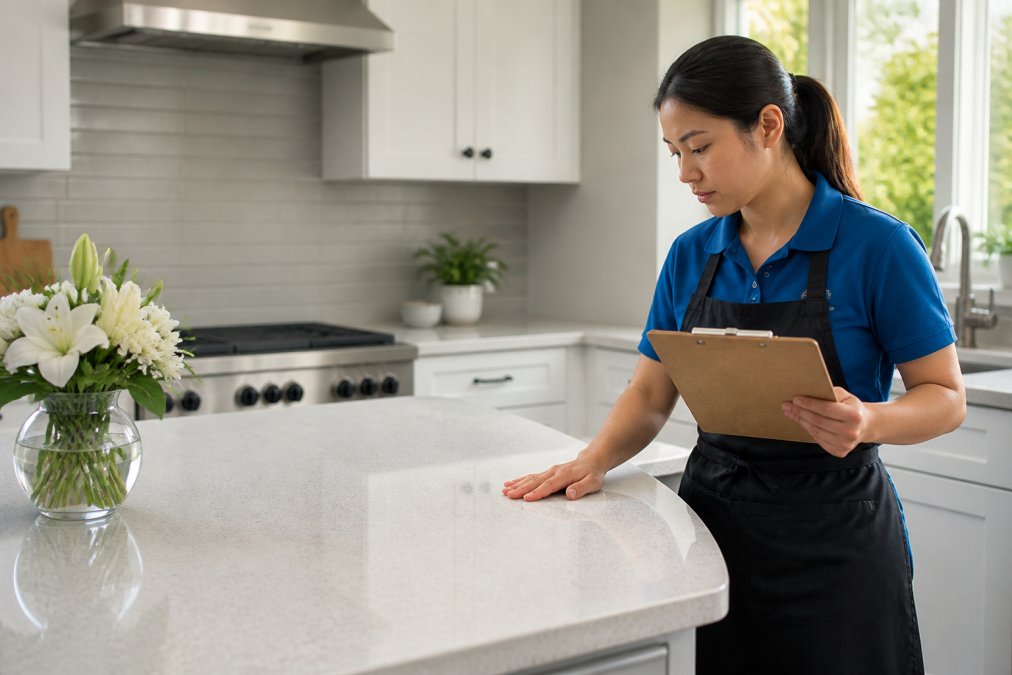
A house cleaning quality control checklist is a room-by-room list of inspection points a supervisor or client uses to confirm the work meets the standard. It turns “looks clean” into pass or fail.
Room-by-Room Inspection Points
| Room | Key Inspection Points | Common Miss |
|---|---|---|
| Kitchen | Counters, sink, stovetop, cabinet fronts, floor edges | Grease behind the faucet |
| Bathroom | Toilet base, grout, mirror, fixtures, floor corners | Mildew in the shower track |
| Bedrooms | Dust lines, under-bed, mirrors, light switches | Dust on the headboard |
| Living areas | Baseboards, vents, upholstery, glass | Streaks on glass tables |
| Entryways | Floors, mats, door frames, handles | Fingerprints on door edges |
Score each room pass or fail, and send anything that fails back to the cleaner before the job closes. This catches problems while the cleaner is still on site and fixes most quality complaints.
How to Provide Feedback to Your Cleaning Service
Feedback works best when it’s specific, timely, and tied to the checklist. “The bathroom wasn’t great” gives a cleaner nothing to fix. “The shower grout wasn’t scrubbed” gives them a task.
Follow this pattern:
- Name the room and the item. Point to the exact spot.
- Say what the standard is. Reference the checklist line.
- Ask for a re-clean if needed. Most services, including ours, will return to fix a miss.
- Log it. One note per issue, with the date and the cleaner.
- Review the log weekly. Patterns show up fast.
Never give feedback only at the end of the month. By then the cleaner can’t connect the note to the visit, and the same miss repeats. Report issues within a day.
Technology-Driven Quality Assurance and Digital Auditing Tools
Digital auditing tools replace paper checklists with photo-verified inspections, timestamps, and dashboards. This is the biggest gap in most cleaning operations, and it’s where quality becomes provable instead of assumed.
What a Digital QA Stack Actually Includes
Most platforms bundle the same core functions. Know what each does before you buy:
- Photo-verified task completion. The cleaner photographs the finished area, inside the oven, the shower track, the baseboard line, and the photo attaches to that task on that visit. No photo, no pass.
- GPS and time-stamped check-in/check-out. Confirms arrival and completion windows without a phone call. Useful for both accountability and payroll.
- Digital checklists with conditional logic. Tapping a box is faster than filling out a form, and conditional steps (“if pets present, do X”) keep the SOP attached to the task instead of buried in a binder.
- Pass/fail scoring per room. The inspector marks each line pass or fail, and a failed line auto-generates a re-clean task before the crew leaves the site.
- Dashboards by cleaner, site, and week. This is the real payoff. You can see that Site A runs 96% pass and Site B runs 71%, or that one cleaner’s bathroom scores dropped after a route change.
- Client portals. Clients view the same record you do, which cuts the “did they even clean the bathroom?” email thread to zero.
How to Roll It Out Without Breaking Your Crew
Adoption is where most digital QA programs stall: a full-platform launch on day one, then quiet reversion to paper within a month. Avoid that with a staged rollout:
- Start with photos only. One task per room, one photo each. Two weeks.
- Add the digital checklist. Same items as your paper version, no new standards yet.
- Turn on scoring and dashboards. Now you have data worth reviewing.
- Open the client portal last. Only after your internal pass rates are stable.
Pick tools your cleaners can use one-handed on a phone. If a task takes more than three taps, it won’t get done on a tight schedule, and a skipped log is worse than no log, because it looks like the work was skipped too.
The Trade-Offs Nobody Mentions
Digital QA is not friction-free. Expect these:
- Time cost per job. Photo verification typically adds a few minutes per visit. Build that into your time targets rather than asking cleaners to absorb it.
- Subscription cost. Per-seat or per-location pricing scales with your crew, so model it against your job volume before committing.
- Data hygiene. A dashboard full of skipped logs is noise. Enforce completion or the data is worthless.
- Privacy and consent. Photographing inside a client’s home requires clear written consent in your service agreement, and you should have a retention and deletion policy for those images.
If you’d rather not manage that stack yourself, Fresh Element Cleaning Co. handles this layer for you, with a 100% satisfaction guarantee behind the work.
IoT and Sensor-Based Verification (Where This Is Heading)
A newer layer sits above photo checklists: sensors and connected devices that verify conditions without a human in the loop, restroom traffic counters that trigger cleaning thresholds, air-quality sensors that flag when a space needs attention, supply dispensers that report when they’re empty. For residential work the ROI is thin today, but for commercial and multi-site portfolios it’s the direction the category is moving.
A Simple Weekly QA Review
Technology only pays off if someone reads the output. Block 30 minutes weekly and review:
- Pass rate by site, flag anything below your target.
- Pass rate by cleaner, look for outliers, not rankings.
- Repeat failures, the same line failing three weeks running is an SOP problem, not a people problem.
- Photo spot-check, pull five random completed tasks and confirm the photos match the standard.
Root Cause Analysis: When Cleaner Quality Slips
Root cause analysis means finding the reason a quality failure happened, not just fixing the visible symptom. Re-cleaning a missed spot solves today’s problem; finding out why it was missed solves the next ten.
The Four Failure Categories
Before you ask a single “why,” classify the failure. Nearly every quality miss traces to one of four roots:
- Standard failure. The cleaner didn’t know what “done” looked like. The SOP was vague, missing, or contradicted by a verbal instruction.
- Tool and supply failure. The right product or equipment wasn’t on the cart, was empty, or was broken.
- Training failure. The cleaner knew the standard but hadn’t been shown the technique, dwell time, edge work, grout scrubbing.
- Capacity failure. The schedule was too tight to finish to standard. This is the one most often misdiagnosed as laziness.
A Worked Example
Say a client reports mildew in the shower track for the third visit in a row.
- Define the failure. One item, one room, three dates.
- Ask why. Why was the track missed? The cleaner says there was no grout brush on the cart.
- Ask why again. Why no brush? Supplies weren’t restocked after the last job.
- Ask why again. Why weren’t they restocked? No restock step exists in the SOP, and no one owns it.
- Fix the cause. Add a restock-and-verify step to the end-of-day SOP, assign it to the crew lead, and log it.
- Verify the fix. Check the shower track on the next three visits and confirm the brush is on the cart at check-in.
The Five Whys, Applied to Cleaning
The five-whys method is a standard troubleshooting technique: ask “why” repeatedly until you reach a cause you can actually change. In cleaning, three or four whys usually gets you there. Stop when the answer is a process, a tool, or a training gap, not a person.
If your fifth “why” is “because the cleaner doesn’t care,” you’ve stopped too early. That’s a conclusion, not a cause. Keep asking until you reach something you can write into the SOP.
Build a Failure Log
You can’t spot patterns you don’t record. Keep a log with four columns:
- Date
- Room and item
- Cleaner and site
- Root cause category (standard, tool, training, capacity)
Re-cleaning fixes a visit. Root cause analysis fixes a quarter. The companies with the most consistent quality aren’t the ones with the best cleaners, they’re the ones who treat every miss as a system clue.
When to Escalate
Some failures aren’t system problems. Repeated, deliberate shortcuts after documented retraining, or damage caused by negligence, are performance issues, handle those through your normal HR process, but only after ruling out the four categories above. Accusing a cleaner of a system failure is the fastest way to lose good staff.
Sustainability and Green Cleaning Consistency
Green cleaning only counts if it’s consistent. A non-toxic product used on two visits and skipped on the third doesn’t protect anyone.
To keep green cleaning consistent:
- Standardize the product list. One approved set, used every visit.
- Write it into the SOP. Which product, which surface, which dilution.
- Train on dwell time. Green products often need longer contact time to work.
- Verify with photos. Same proof standard as any other task.
- Review quarterly. Swap products only with a documented reason.
Conclusion
Consistent cleaner quality isn’t a personality trait. It’s a system: written SOPs, a room-by-room checklist, fast feedback, and a way to verify the work.
Frequently Asked Questions
What is the 80/20 rule in house cleaning?
The 80/20 rule in house cleaning means 80% of visible results come from 20% of high-impact tasks. Focus your quality control checklist on those tasks: kitchen surfaces, bathroom fixtures, floors, and entryways. These areas shape how clean a home feels to clients. If you get these right consistently, overall satisfaction stays high even when smaller details vary.
How do you measure the quality of a cleaning service?
Measure cleaner quality through site inspections, client feedback scores, and re-clean rates. Use a standardized checklist to score each room after every visit. Track performance metrics like on-time arrival, task completion percentage, and client satisfaction ratings over time. A service level agreement that defines cleaning standards gives you a baseline to compare against. Consistent measurement reveals patterns before small issues become client complaints.
Why does cleaning quality fluctuate between visits?
Quality fluctuates when staff lack clear standard operating procedures, when different cleaners rotate through the same home without shared notes, or when time pressure cuts corners. Without a feedback loop and documented cleaning protocols, each visit becomes a fresh start. Assigning the same team to recurring clients, using cleaning checklists, and conducting regular site inspections reduce that variability significantly.
What should be included in a professional cleaning checklist?
A professional cleaning checklist covers every room with specific tasks: dusting surfaces and fixtures, wiping baseboards, vacuuming carpets, mopping hard floors, sanitizing bathrooms, and cleaning kitchen appliances. Include frequency notes (daily, weekly, monthly) and a scope of work that defines what is and is not covered. Add a re-clean policy so clients know what happens if something is missed.