Eco-Friendly House Cleaning Benefits: A Complete Guide
Table of Contents
- Why Eco-Friendly House Cleaning Benefits Matter
- Improved Indoor Air Quality and Cleaning Supplies
- Health Protection for Children and Pets
- Non-Toxic Cleaning Products for Home Safety
- Eco-Friendly Cleaning vs Conventional Cleaning: What Actually Works
- Environmental and Long-Term Surface Health Benefits
- Making the Switch: Label Literacy and Avoiding Greenwashing
- Frequently Asked Questions
Last Updated: September 18, 2026
Why Eco-Friendly House Cleaning Benefits Matter
The shift toward eco-friendly house cleaning benefits isn’t just a trend, it’s a response to something many households are finally acknowledging: conventional cleaning products come with real costs that go beyond the price tag. When you choose eco-friendly cleaning solutions, you’re making a deliberate decision about what you’re exposing your family to every single day.
At Fresh Element Cleaning Co., we’ve observed firsthand how households transform when they switch from harsh chemical cleaners to non-toxic alternatives. The benefits extend far beyond a spotless surface. Families report fewer respiratory issues, pets stop showing signs of irritation, and the air in their homes actually feels fresher. These aren’t coincidental improvements, they’re direct results of eliminating volatile organic compounds (VOCs) and synthetic fragrances that conventional products release into your living space.
The eco-friendly house cleaning benefits conversation often gets oversimplified. People assume it’s either about environmental guilt or paying a premium for “feel-good” products. Neither is accurate. What the research actually shows is that eco-friendly cleaning delivers measurable improvements in indoor air quality, health outcomes for vulnerable populations, and long-term surface integrity. The environmental impact is real, but it’s a bonus to the immediate, tangible benefits you experience at home.
Improved Indoor Air Quality and Cleaning Supplies
Your home’s air quality directly influences respiratory health, energy levels, and how you feel day to day. Conventional cleaning products release volatile organic compounds into your indoor environment, substances that linger in the air long after you’ve finished cleaning (the EPA).
Eco-friendly cleaning supplies work differently. They’re formulated without synthetic fragrances, phthalates, and harsh chemical solvents that off-gas into your home. Instead, naturally derived ingredients like citrus extracts, plant-based surfactants, and essential oils clean effectively without the toxic vapor release. The air in your home stays cleaner because you’re not introducing chemical pollutants every time you mop or spray a surface.
One practical difference: with conventional cleaners, you often smell a strong artificial scent. That smell is the product off-gassing, those are chemicals entering your lungs. With eco-friendly alternatives, you might notice a subtle lemon or lavender scent, or no scent at all. That absence isn’t a sign of weakness; it’s evidence the product isn’t filling your air with volatile compounds.
The relationship between indoor air quality and cleaning supplies matters most in homes where people spend significant time indoors. Children, elderly family members, and anyone with existing respiratory sensitivity notice the difference immediately. Reduced chemical exposure means fewer headaches, less throat irritation, and better sleep quality, outcomes that compound over weeks and months of consistent use.
Test your current cleaning routine by opening windows while cleaning with conventional products, then notice the smell dissipate. With eco-friendly alternatives, you’ll find the air clears faster because fewer volatile compounds are being released.
Health Protection for Children and Pets
Children and pets are disproportionately vulnerable to chemical exposure from household cleaners (the CDC). Their bodies are smaller, their immune systems are still developing, and they interact with cleaned surfaces in ways adults don’t, crawling on floors, putting hands in their mouths, spending hours in spaces you’ve just cleaned.
Conventional cleaning products contain chemicals that are toxic at high concentrations but are used in homes at lower levels with the assumption of safety. The problem is cumulative exposure. A child exposed to trace amounts of ammonia, bleach, and synthetic fragrances daily over months and years experiences a different risk profile than the occasional exposure. Eco-friendly cleaning products eliminate this cumulative burden entirely.
Pet-safe cleaning solutions matter because animals lack the ability to avoid treated surfaces. They walk across floors you’ve just cleaned, breathe the air you’ve filled with cleaning chemicals, and sometimes ingest residue when they groom their paws. Pets show signs of chemical sensitivity more visibly than humans, excessive scratching, respiratory symptoms, or behavioral changes, making them early warning signs of problematic cleaning practices.
When you switch to non-toxic cleaning products for home use, you’re removing a source of daily chemical exposure for your entire household. The difference is particularly noticeable in homes with young children or pets with sensitivities. Behavioral improvements, reduced allergic reactions, and better overall health markers often follow within weeks.
The safety margin for children and pets with eco-friendly products isn’t theoretical, it’s the elimination of a known toxin source, not just a reduction in risk.
Non-Toxic Cleaning Products for Home Safety
Non-toxic cleaning products for home safety represent a fundamental shift in how you approach household sanitation. Rather than assuming that “strong chemical smell equals clean,” these products deliver actual cleaning efficacy through different mechanisms.
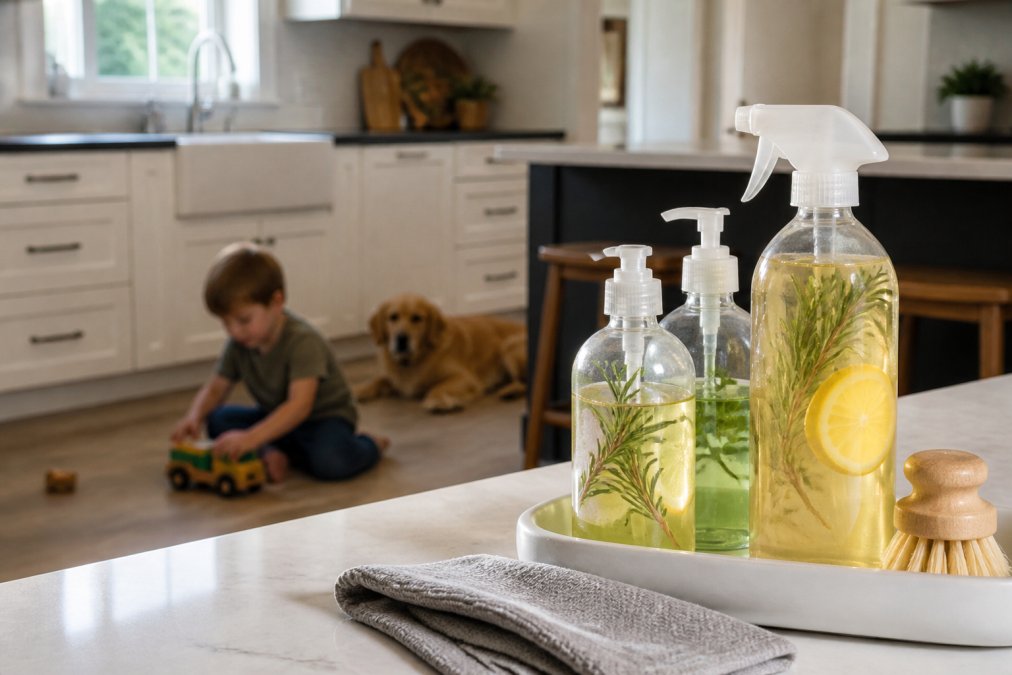
Naturally derived cleaning ingredients work through chemistry that’s been understood for decades. Citric acid cuts through mineral deposits and soap scum. Plant-based surfactants break down oils and grease. Hydrogen peroxide provides antimicrobial action without leaving toxic residue. These aren’t “gentler” alternatives that sacrifice performance, they’re different chemical approaches that achieve the same cleaning outcomes without the health risks.
The practical advantage: you can use these products around food preparation areas, children’s toys, and pet bedding without concern. You don’t need to ventilate aggressively or worry about residue. You can let your child play on a floor you’ve just mopped. These aren’t theoretical safety margins, they’re practical differences in how you live in your home.
A common mistake is assuming eco-friendly means less effective. The actual distinction is between toxic efficacy and safe efficacy. A conventional bleach-based cleaner kills bacteria through harsh chemical action that also damages human tissue at high concentrations. An eco-friendly disinfectant achieves the same antimicrobial result through different chemistry that doesn’t pose the same toxicity risk. Both work. One doesn’t poison your home in the process.
Fresh Element Cleaning Co. uses non-toxic cleaning products throughout all our residential services specifically because effectiveness and safety aren’t competing priorities. The products we choose clean as thoroughly as conventional alternatives while eliminating chemical exposure for your family and pets.
Eco-Friendly Cleaning vs Conventional Cleaning: What Actually Works
The comparison between eco-friendly cleaning and conventional cleaning gets muddied by marketing claims on both sides. The actual difference comes down to efficacy, health impact, and long-term outcomes.
Conventional cleaners often rely on high concentrations of active chemicals, bleach, ammonia, quaternary ammonium compounds, that work through aggressive chemical action. They’re fast, they produce visible results, and they leave a strong scent that people interpret as “clean.” The trade-off is chemical exposure and environmental impact.
Eco-friendly cleaning approaches use lower concentrations of active ingredients but achieve results through different mechanisms. Plant-based surfactants, naturally derived antimicrobials, and pH-balanced formulas work more slowly but deliver comparable results without the toxicity profile. They don’t leave chemical residue on surfaces or in the air.
The practical difference emerges over time. A surface cleaned with conventional bleach-based products may show spotless results immediately but accumulates chemical residue with repeated use. That residue can degrade surface integrity, particularly on natural stone or wood. Eco-friendly products clean without this degradation, meaning your surfaces maintain their condition longer.
| Comparison Factor | Conventional Cleaning | Eco-Friendly Cleaning |
|---|---|---|
| Immediate cleaning speed | Fast | Moderate |
| Chemical residue on surfaces | High | None |
| Indoor air quality impact | Negative (VOCs released) | Neutral to positive |
| Long-term surface integrity | Degradation over time | Maintained |
| Health risk from exposure | Present | Eliminated |
| Environmental footprint | High | Low |
The efficacy question matters most. Both approaches work. The question is what trade-offs you’re accepting. With conventional cleaners, you’re accepting chemical exposure and environmental impact for slightly faster results. With eco-friendly alternatives, you’re accepting slightly longer cleaning times for safety and sustainability.
A common pitfall is using insufficient eco-friendly product or not allowing adequate contact time, then concluding the product “doesn’t work.” Most eco-friendly cleaners require 5-10 minutes of contact time on surfaces, a step that conventional products often skip due to their harsher chemistry.
Environmental and Long-Term Surface Health Benefits
The environmental impact of eco-friendly house cleaning benefits extends beyond your home into water systems, soil, and ecosystems where cleaning wastewater eventually flows. Conventional cleaning products contain chemicals that don’t biodegrade quickly, accumulate in aquatic environments, and persist in soil.
Biodegradable ingredients break down into harmless components within weeks or months. Non-biodegradable synthetic chemicals persist for years. When you choose eco-friendly cleaning solutions, you’re choosing products that return to the environment as benign compounds rather than accumulating as persistent pollutants. This matters whether you live near waterways or not, all household wastewater eventually reaches aquatic systems.
The surface health angle is often overlooked.
Making the Switch: Label Literacy and Avoiding Greenwashing
Not all products labeled “eco-friendly” or “green” deliver the benefits they claim. Greenwashing, marketing products as environmentally friendly or safe when they’re not, is rampant in the cleaning category. Learning to read labels and identify authentic eco-friendly products is essential.
Frequently Asked Questions
What does eco-friendly cleaning mean for your household?
Eco-friendly cleaning means using non-toxic, naturally derived products that clean effectively without releasing volatile organic compounds (VOCs) or synthetic fragrances into your home. These products are biodegradable, safer for children and pets, and reduce your household’s chemical exposure. The goal is a spotless, sanitized space that doesn’t compromise your family’s respiratory health or contribute to indoor air pollution.
Are eco-friendly cleaning products as effective as conventional ones?
Yes, when chosen correctly. Modern eco-friendly cleaning products deliver comparable cleaning efficacy to conventional cleaners for routine household tasks. The difference lies in how they work: plant-based formulas and naturally derived ingredients clean surfaces without harsh chemical residues. For stubborn stains or specialized needs, some eco-friendly options perform equally well; the key is selecting products designed for your specific cleaning challenge rather than assuming all green cleaners are weaker.
How do green cleaning products improve indoor air quality?
Conventional cleaners release volatile organic compounds (VOCs) and synthetic fragrances that linger in your home, degrading indoor air quality and triggering respiratory issues or allergies. Eco-friendly cleaning supplies eliminate or drastically reduce these emissions. By switching to non-toxic, naturally derived products, you reduce chemical off-gassing, lower allergen concentrations, and create a healthier breathing environment, especially important for households with children, pets, or existing respiratory sensitivities.
What ingredients should you avoid in conventional cleaning supplies?
Avoid products containing phthalates (which disrupt hormones), ammonia, chlorine bleach, synthetic fragrances, and harsh surfactants that don’t biodegrade. These ingredients contribute to indoor air pollution, water contamination, and chemical exposure. Read labels carefully: if ingredients aren’t listed or the label says ‘fragrance’ without specifics, that’s a red flag. Look instead for naturally derived, biodegradable alternatives that disclose their full ingredient list and carry eco-friendly certifications.