Schedule Recurring Office Cleaning Services: 2026 Guide
Table of Contents
- Why Recurring Office Cleaning Services Beat On-Demand Visits
- How to Schedule Recurring Office Cleaning Services in 6 Steps
- Step 1: Audit Your Space and Foot Traffic
- Step 2: Set Frequency with a Commercial Cleaning Frequency Guide
- Step 3: Build the Checklist Before You Talk to Providers
- Step 4: Vet Providers on Operations, Not Just Price
- Step 5: Negotiate the Service Level Agreement
- Step 6: Lock In the First Visit and Automate the Cadence
- Commercial Cleaning Frequency Guide: Daily, Weekly, or Monthly?
- Build an Office Cleaning Checklist Template That Crews Follow
- How to Hire a Commercial Cleaning Company You Can Trust
- Security, Access, and Green Cleaning Integration
- Frequently Asked Questions
Last Updated: September 20, 2026
Why Recurring Office Cleaning Services Beat On-Demand Visits
Recurring office cleaning is a scheduled cleaning arrangement where a professional crew visits your workspace on a fixed cadence, typically weekly or bi-weekly, rather than being booked only when conditions demand it. For most offices, the recurring model wins on cost, consistency, and hygiene.
Cost-Benefit Analysis: Recurring vs. On-Demand
Recurring service trades flexibility for predictability, and for a fixed office footprint that trade almost always pays off. On-demand cleaning suits irregular spaces: a pop-up retail booth, a rental turnover, a one-time post-event cleanup. An office with steady occupancy is a different animal.
| Factor | Recurring Contract | On-Demand Booking |
|---|---|---|
| Per-visit cost | Lower, locked in | Higher, variable |
| Scheduling | Fixed cadence | Subject to availability |
| Crew familiarity | High, same team | Low, rotating staff |
| Hygiene baseline | Maintained | Spikes then drops |
| Budgeting | Predictable | Hard to forecast |
The real cost of on-demand cleaning isn’t the invoice. It’s the emergency deep clean you book after three weeks of skipped detail work, plus the productivity drag of a workspace nobody wants to use.
How to Schedule Recurring Office Cleaning Services in 6 Steps
Scheduling recurring office cleaning services takes six steps: audit your space, set a frequency, build a checklist, vet providers, negotiate a service level agreement, and lock in your first visit. Here’s how each step works, with the operational detail that keeps a recurring plan from falling apart in month two.
Step 1: Audit Your Space and Foot Traffic
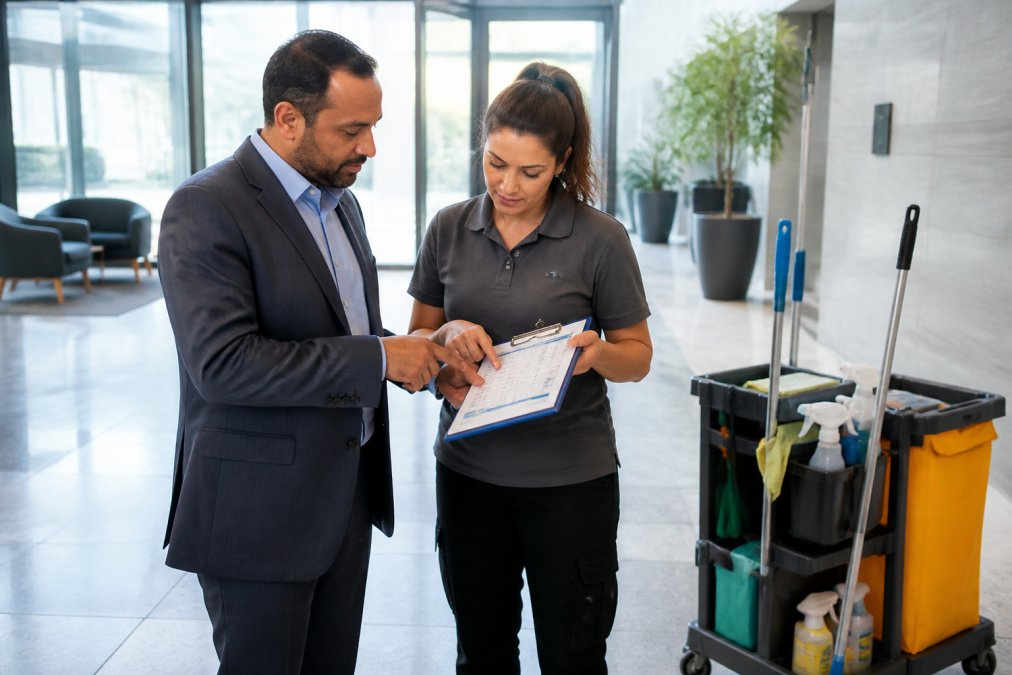
Walk your office and count the variables that drive cleaning needs: square footage, restroom count, breakroom size, and how many people pass through daily. A 20-person administrative suite and a 60-person open floor plan need very different service levels even at the same square footage. Note high-touch surfaces too, since door handles, shared keyboards, and elevator buttons collect more grime than floors.
Step 2: Set Frequency with a Commercial Cleaning Frequency Guide
Match frequency to actual use, not habit. A commercial cleaning frequency guide maps tasks to how often they genuinely need doing, and it prevents both overspending on daily service you don’t need and under-cleaning the areas that matter. A five-person office can often run on bi-weekly visits. A customer-facing space with heavy foot traffic usually needs daily attention.
Step 3: Build the Checklist Before You Talk to Providers
Draft your office cleaning checklist template first, then hand it to every provider you interview. Providers who quote against a written scope give you apples-to-apples numbers; providers who quote against a vague description pad the price to cover the unknown. The checklist also becomes the exhibit attached to your contract, which is what makes quality enforceable later.
Step 4: Vet Providers on Operations, Not Just Price
Ask how crews are assigned, how a substitute is trained when your regular cleaner is out, and what happens on a holiday week. A provider that can’t describe its own coverage plan will improvise on your account. Confirm insurance with a certificate, and ask for two references at offices of similar size and traffic, not the showpiece account they send everyone.
Step 5: Negotiate the Service Level Agreement
The SLA is where scheduling promises become obligations. Lock in exact days, arrival windows, and the remedy for a missed visit. This is also the step where you decide whether the provider uses scheduling software you can see into, or whether you’ll be trading emails every time a visit shifts.
Step 6: Lock In the First Visit and Automate the Cadence
Schedule the first visit as a walkthrough with the crew lead so they see the space before they clean it. From there, move the cadence into a recurring calendar or a client portal so visits, invoices, and checklists live in one place. Automation is what turns a one-time booking into a recurring service that runs without you re-confirming it every month.
Steps 1 through 3 are yours to own; steps 4 through 6 are where a provider either earns a long-term contract or reveals that it can’t. Do the audit and checklist work up front and the back half of the process gets much shorter.
Commercial Cleaning Frequency Guide: Daily, Weekly, or Monthly?
A commercial cleaning frequency guide assigns each task a cadence based on foot traffic, occupancy rates, and how quickly surfaces get soiled. Restrooms and high-touch surfaces need daily attention in almost any occupied office. Floors and breakrooms typically land on a weekly cycle. Deep tasks like carpet extraction and vent cleaning can stretch to monthly or quarterly.
- Daily: restroom sanitation, trash removal, high-touch surface disinfection, breakroom wipe-down
- Weekly: floor care, dusting, glass and mirror cleaning, full breakroom maintenance
- Monthly: deep carpet cleaning, baseboard and vent dusting, interior window washing
- Quarterly: floor stripping and waxing, upholstery cleaning, full sanitation protocol review
How Foot Traffic Actually Changes the Cadence
Frequency isn’t a preference; it’s a function of traffic. A common pattern is to count daily entries at the front door and restroom door for one week, then set restroom and high-touch cadences against that number rather than against square footage alone. A 10,000-square-foot office with 80 daily visitors and one with 15 daily visitors are not the same cleaning job, even though the floor plan looks identical on a lease.
Where Scheduling Software Fits In
Most providers now run recurring visits through scheduling software that assigns crews, routes them, and pushes the checklist to a phone or tablet on arrival. That matters to you for three reasons: you can usually see visit history and completion photos in a client portal, reschedules propagate automatically instead of triggering a phone call, and the provider can prove a visit happened when a dispute arises.
The ROI Case for Recurring Over On-Demand
This is the part most frequency guides skip. On-demand cleaning prices each visit at a premium because the provider is fitting you into route gaps. A recurring contract lets the provider plan labor, supplies, and routing around your space, and that predictability is what produces the lower per-visit rate. The financial case isn’t just the lower invoice, it’s the avoided cost of the emergency deep clean that follows a month of skipped detail work, plus the productivity drag of a workspace employees avoid.
Skipping daily restroom sanitation to save on a recurring contract is a false economy. Restrooms are the first thing employees and visitors judge, and a neglected one generates complaints that outlast any budget you saved.
Ask a prospective provider to quote both a recurring plan and a per-visit on-demand rate for the same scope. The gap between the two numbers is your clearest evidence of what predictability is worth in your market.
Build an Office Cleaning Checklist Template That Crews Follow
An office cleaning checklist template is a written, room-by-room list of tasks and their frequency that a crew works from on every visit. It removes guesswork and gives you a way to verify the work. Without one, “clean” means whatever the cleaner decides that day.
- Reception: wipe front desk, disinfect door handles, vacuum entry mat, clean glass
- Restrooms: sanitize fixtures, restock supplies, mop floors, empty trash
- Breakroom: wipe counters, clean microwave and fridge exterior, sanitize sink, remove trash
- Workstations: dust surfaces, empty desk bins, spot-clean shared equipment
- Conference rooms: wipe tables, sanitize chairs and remotes, vacuum, reset whiteboards
How to Hire a Commercial Cleaning Company You Can Trust
Hiring a commercial cleaning company you can trust comes down to verification: confirm insurance, ask how they staff and supervise crews, and get every promise in writing. Anyone can quote a low number. Fewer can show you a trained, insured, supervised team that shows up on schedule.
Ask every candidate the same questions:
- Are you insured and can you provide a certificate?
- Will the same crew service our office each visit?
- How do you handle a missed or late visit?
- What’s your process for a complaint or a re-clean?
Contract Negotiation and Service Level Agreements
A service level agreement is the written section of your cleaning contract that defines exactly what gets cleaned, how often, and what happens when the provider falls short. Most offices skip this and regret it. The SLA is where you lock in the terms that protect you.
Insist on these clauses before signing:
- Scope: the checklist, attached as an exhibit
- Frequency: exact days and cadence
- Response time: how fast the provider handles a complaint
- Missed-visit remedy: a credit or a re-clean, stated plainly
- Cancellation and rescheduling: notice period and any fees
Security, Access, and Green Cleaning Integration
Security and access management belong in your cleaning contract, not in a separate conversation. Your crew will be in the building after hours, often alone. Decide up front how they get in, who holds keys or codes, and how access is revoked if a staff member leaves.
Practical controls that work:
- Use a keypad or fob system you can update instantly
- Keep a signed access log for every crew member
- Require background checks and confirm them in writing
- Set a clear after-hours protocol for alarms and locked areas
Ask your provider to photograph the finished space after each recurring visit. It takes them seconds, gives you a record for quality control, and settles any “was it actually cleaned?” dispute without a phone call.
Frequently Asked Questions
How often should an office be professionally cleaned?
Most offices need professional cleaning two to three times per week. High-traffic spaces like restrooms, breakrooms, and reception areas often need daily attention for surface disinfection, trash removal, and high-touch surfaces. Smaller administrative suites with low occupancy rates may do well with bi-weekly visits. A commercial cleaning frequency guide that factors in square footage, foot traffic, and occupant count will give you a defensible schedule rather than a guess.
What factors influence the cost of recurring commercial cleaning?
Pricing depends on square footage, visit frequency, occupant count, and the scope of tasks in your cleaning checklists. Restroom sanitation, floor care, and breakroom maintenance add labor hours. Green cleaning products and after-hours access requirements can also shift the total. Because every building differs, request a walkthrough quote from Fresh Element Cleaning Co. rather than comparing flat rates, which rarely reflect the actual work.
What should I include in my weekly cleaning schedule?
A solid weekly schedule covers restroom sanitation, trash removal, floor care, breakroom maintenance, and surface disinfection of high-touch surfaces like door handles and shared keyboards. Daily tasks handle restrooms and trash, while weekly or bi-weekly tasks cover deeper work like vacuuming under furniture and wiping interior glass. Using an office cleaning checklist template keeps crews consistent and gives you a written record to review against your service level agreement.
How do I choose the right commercial cleaning company for my office?
Start by verifying insurance, bonding, and references from similar facilities. Ask how they handle staffing ratios, back-up coverage when a crew member calls out, and access management for after-hours visits. Request a written service level agreement that spells out visit frequency, task lists, and response times for complaints. A family-owned provider like Fresh Element Cleaning Co. can often offer more direct on-site management than a large franchise.