Best Practices for Office Sanitation in 2026
Table of Contents
- Why Office Sanitation in 2026 Demands a New Approach
- The 2026 Office Cleaning Checklist: Daily, Weekly, and Seasonal Tasks
- Building an Office Cleaning Schedule That Fits Your Occupancy
- High-Touch Surface Cleaning: Contact Times and Correct Products
- Office Cleaning Supplies Checklist: What Your Team Actually Needs
- Chemical Safety, Staff Training, and Measuring Sanitation Performance
- Common Office Sanitation Mistakes and How to Avoid Them
- Conclusion: Turning Best Practices Into Daily Habits
- Frequently Asked Questions
Last Updated: October 13, 2026
Why Office Sanitation in 2026 Demands a New Approach
Office sanitation is the routine practice of cleaning, disinfecting, and maintaining shared workspaces to reduce pathogens, allergens, and contaminants on surfaces and in the air. In 2026, that job looks different than it did five years ago. Hybrid schedules mean desks sit empty for days and then get shared, occupancy swings week to week, and employees notice whether a workspace actually feels clean.
The 2026 Office Cleaning Checklist: Daily, Weekly, and Seasonal Tasks
An effective office cleaning checklist separates tasks by frequency so nothing critical gets skipped and nothing trivial gets overdone. Daily work targets high-traffic, high-touch areas. Weekly and seasonal work handles the deeper jobs that keep a building healthy over time. The table below maps each frequency to its core tasks.
| Frequency | Core Tasks | Best For |
|---|---|---|
| Daily | High-touch surfaces, restrooms, break room, trash | Occupied spaces |
| Weekly | Vacuuming, dusting, floor care, upholstery | All offices |
| Seasonal | Deep cleaning, air ducts, carpets, windows | Long-term upkeep |
Daily Cleaning Tasks
Daily cleaning covers the surfaces people touch constantly: doorknobs, light switches, elevator buttons, shared desks, screens, and keyboards. Restrooms need cleaning and restocking of soap, paper, and sanitizer. The break room requires counter and appliance wiping plus trash removal. These tasks matter most because they interrupt the spread of germs at the point of contact.
Weekly and Seasonal Deep Cleaning
Weekly work reaches what daily cleaning misses: vacuuming carpets, dusting vents and ledges, and refreshing upholstery. Seasonal deep cleaning tackles air ducts, window washing, and carpet extraction. According to guidance from the U.S. Environmental Protection Agency on indoor air quality, ventilation and source control play a major role in indoor air quality, which is why duct and filter maintenance belongs on the seasonal list rather than the daily one.
Building an Office Cleaning Schedule That Fits Your Occupancy
The right office cleaning schedule follows occupancy, not the calendar alone. A workspace used by five people three days a week needs a different rhythm than a fully staffed floor.
- High occupancy, daily use: daily cleaning plus a weekly deep pass
- Hybrid, partial occupancy: daily touch-point disinfection on occupied days, weekly deep cleaning
- Low occupancy or hot-desking: daily high-touch cleaning on shared equipment, seasonal deep cleaning
Occupancy density and operating hours should drive the plan. A common mistake is applying one schedule to every area; a busy break room and a rarely used conference room do not need the same treatment.
High-Touch Surface Cleaning: Contact Times and Correct Products
High-touch surface cleaning works only when the product stays wet on the surface for its full contact time. Contact time is the period a disinfectant must remain visibly wet to kill the pathogens its label claims to kill.
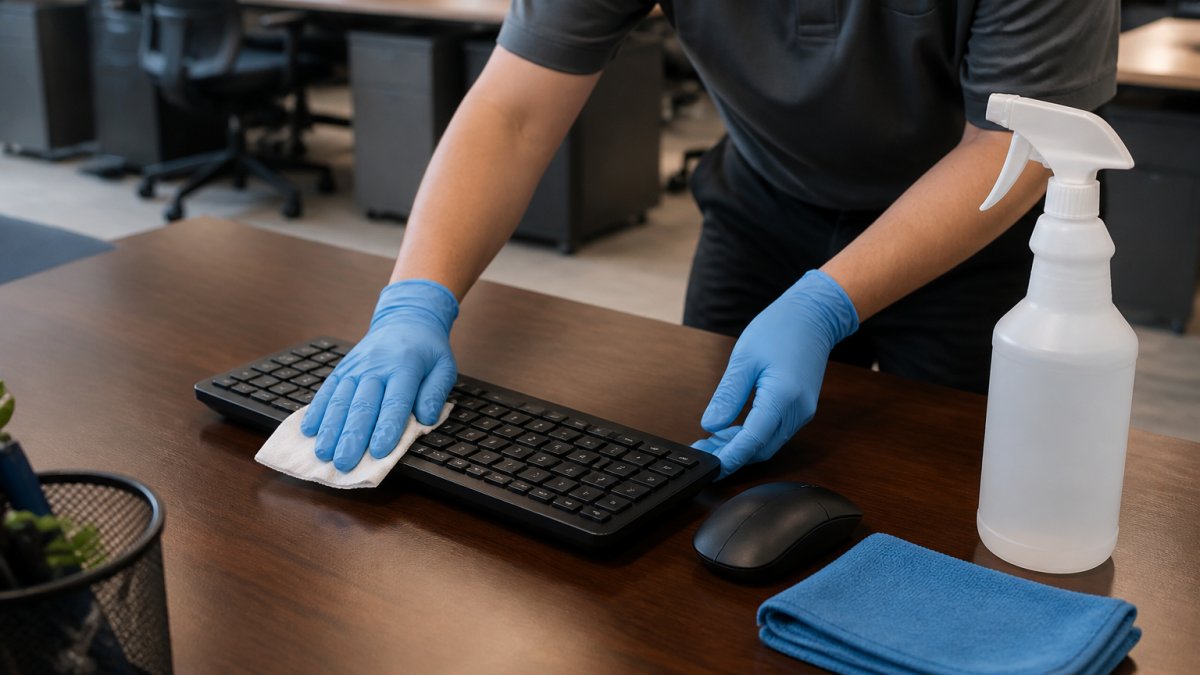
Read the product label and follow its stated contact time, which varies by product. The CDC guidance on cleaning and disinfecting recommends cleaning visibly dirty surfaces before disinfecting, because soil can reduce how well a disinfectant works.
On shared keyboards and touchscreens, spray the cloth, never the device. Liquid pushed into key gaps or screen edges is one of the most common causes of damaged office equipment.
Office Cleaning Supplies Checklist: What Your Team Actually Needs
A practical office cleaning supplies checklist prevents mid-task shortages and keeps staff working from the same standard. The list below goes beyond the generic version most offices use by pairing each item with the reason it belongs in the kit and the safety detail that keeps it effective.
- EPA-registered disinfectant with a known contact time, choose products labeled for the pathogens you actually target, and note the dwell time on the label before buying in bulk.
- Disinfecting wipes for shared equipment, convenient for keyboards, mice, and phones, but check that the wipe’s label lists electronics-safe use.
- Microfiber cloths, color-coded by area, assign one color to restrooms, another to break rooms, another to general surfaces, so a restroom cloth never touches a desk.
- Two-bucket or dual-compartment mop system, keeps rinse water separate from cleaning solution and slows cross-contamination on floors.
- Hand soap and hand sanitizer, stock both; sanitizer is a supplement, not a replacement, for handwashing.
Dilution, Storage, and Safety Data Sheets
Concentrates are where most supply programs go wrong. Dilution ratios are printed on the label for a reason: too strong wastes product and increases chemical exposure, while too weak leaves the disinfectant below the concentration its efficacy claims assume.
Store chemicals in a locked or access-controlled cabinet away from food, break-room counters, and HVAC intakes. Under the OSHA Hazard Communication Standard, employers must maintain safety data sheets for hazardous chemicals in the workplace and ensure they are readily accessible to workers during their shift, not locked in an office only a manager can reach.
Green cleaning products and certified options reduce chemical exposure for staff and occupants, but “green” is not a synonym for “safe to mix.” Never combine a chlorine-based product with an acid-based cleaner, and never mix ammonia with bleach; both combinations can release dangerous fumes.
Photograph the label and safety data sheet for each product and store the images in a shared folder. When a bottle’s label wears off or a new hire needs a refresher, the reference is one tap away instead of a search through a filing cabinet.
Matching Supplies to Space
A single supply kit rarely fits an entire building. Restrooms need dedicated cloths, a disinfectant labeled for restroom surfaces, and restocking supplies staged nearby. Break rooms need food-safe surface cleaners and a separate cloth set. Workstation areas need electronics-safe wipes and a disinfectant with a short enough contact time that staff will actually wait it out. Label each kit by area so supplies don’t migrate and cross-contamination risk stays contained.
Chemical Safety, Staff Training, and Measuring Sanitation Performance
Chemical safety and staff training separate a sanitation program that works from one that only looks busy. Most competitors stop at “train your staff,” which is not a plan. A workable program covers four things: what each product does, how to dilute and apply it, what protective equipment is required, and what to do when something goes wrong.
What Training Must Cover
- Product identity and purpose, staff should know which bottle is a cleaner, which is a sanitizer, and which is a disinfectant, because the three have different label claims and different dwell times.
- Dilution and application, how to measure concentrate, which surfaces each product is approved for, and how long the surface must stay wet.
- PPE and handling, when gloves, eye protection, or aprons are required, and how to remove them without contaminating skin or clothing.
- Hazard communication, where safety data sheets live, how to read the hazard pictograms, and what to do if a product contacts skin or eyes.
- No-mix rules, the specific combinations to avoid, posted where chemicals are stored.
As documented in OSHA’s hazard communication standard, employers must train workers on the hazardous chemicals they use and keep safety information available. Training is not a one-time event; new hires need it before their first shift, and refreshers belong on the calendar whenever a product changes or an incident occurs.
Skipping staff training on contact times is the most common and most costly mistake. A crew that wipes and immediately dries a surface leaves pathogens behind, so the space looks clean while offering little real protection.
Measuring Sanitation Performance
Measuring sanitation performance turns cleaning into something you can manage rather than something you hope is happening. The most useful programs track a small set of repeatable metrics rather than relying on how a space looks.
- Task completion rate, the percentage of scheduled tasks marked done on the daily and weekly checklist, reviewed by area.
- Inspection scores, a scored walkthrough of high-touch surfaces, restrooms, and break rooms, using the same rubric each time so scores are comparable week to week.
- ATP swab results, swabs on high-touch surfaces give a quick read on whether organic residue remains after cleaning; treat results as a trend line, not a pass/fail on a single point.
- Supply availability, the percentage of restroom and break-room checks where soap, paper, and sanitizer were fully stocked.
- Complaint and request rates, occupant reports per area per month, which often surface problems before an inspection does.
Track results by area so you can see which spaces need more attention, and review the numbers on a fixed cadence, weekly for task completion, monthly for inspection scores and complaints.
Role-Based Responsibilities
Sanitation holds up when each group knows its lane. Facilities teams own the schedule, supply inventory, and vendor oversight. Cleaning contractors execute the checklist, log completion, and flag supply or equipment problems. Employees handle the small, high-frequency actions: wiping shared equipment after use, reporting empty dispensers, and keeping personal workspaces clear enough to clean. Posting a one-page responsibility chart near break rooms and restrooms removes the ambiguity that causes gaps.
The single highest-impact change most offices can make is enforcing contact times on high-touch surfaces. It is free, it takes discipline, and it is the difference between cleaning and disinfecting. The second is picking three or four metrics and actually reviewing them on a schedule.
Common Office Sanitation Mistakes and How to Avoid Them
Most sanitation failures come from a handful of repeatable mistakes. Fixing them costs little and changes results fast.
| Mistake | Fix | Impact |
|---|---|---|
| Wiping before contact time | Let surfaces stay wet per label | Real disinfection |
| Same cloth everywhere | Color-code by area | Stops cross-contamination |
| Skipping restroom restock | Add to daily checklist | Fewer complaints |
| Ignoring air ducts | Seasonal duct cleaning | Better indoor air quality |
| One schedule for all areas | Match to occupancy | Efficient effort |
Other frequent problems include using expired products, forgetting frequently touched surfaces like elevator buttons, and letting trash bins overflow. A good inspection routine catches these before occupants notice them.
The single highest-impact change most offices can make is enforcing contact times on high-touch surfaces. It is free, it takes discipline, and it is the difference between cleaning and disinfecting.
Conclusion: Turning Best Practices Into Daily Habits
The challenge with office sanitation is consistency: the best checklist in the world fails if no one follows it on a busy Tuesday. Fresh Element Cleaning Co. builds customized cleaning plans around your occupancy, uses eco-friendly products, and backs every visit with a 100% satisfaction guarantee. Our team handles daily, weekly, and seasonal tasks so your staff can stay focused on work.
Frequently Asked Questions
What should I include on my office cleaning checklist?
A solid office cleaning checklist covers daily tasks like wiping high-touch surfaces, emptying trash bins, and restocking restrooms, plus weekly tasks such as vacuuming carpets, dusting screens, and mopping floors. Add seasonal deep cleaning for air ducts, upholstery, and windows. Break the list into zones: personal workspaces, shared areas, restrooms, and break rooms. Assign each task a frequency and an owner so nothing falls through the cracks.
How often should high-touch office surfaces be cleaned?
High-touch surfaces like doorknobs, light switches, elevator buttons, and shared keyboards should be cleaned and disinfected at least once daily, and more often in high-traffic areas or during cold and flu season. If your office has multiple shifts or high occupancy density, aim for two to three times per day. Disinfecting wipes make quick mid-day touch-ups easy for staff between professional cleaning visits.
What is the difference between cleaning, sanitizing, and disinfecting?
Cleaning removes dirt, dust, and debris from surfaces. Sanitizing reduces bacteria to levels considered safe by public health standards. Disinfecting kills or inactivates most pathogens on surfaces, but only if the product stays wet for its required contact time, which is often several minutes. For office sanitation, you generally clean first, then disinfect high-touch surfaces, and sanitize areas that don’t need full disinfection.
What supplies are needed to sanitize an office?
A basic office cleaning supplies checklist includes microfiber cloths, disinfecting wipes, EPA-registered disinfectant spray, glass cleaner, neutral floor cleaner, vacuum with HEPA filtration, trash liners, and hand sanitizer stations. For restrooms, add toilet bowl cleaner, paper products, and soap refills. Choose certified green cleaning products where possible, and always check that disinfectants carry an EPA registration number for verified effectiveness.
How can a business create an office cleaning schedule?
Start by mapping your office zones and identifying high-traffic areas. Set daily tasks for restrooms, break rooms, and high-touch surface cleaning. Add weekly tasks like vacuuming, dusting, and floor care. Schedule seasonal deep cleaning for carpets, upholstery, and air ducts. Factor in occupancy density and operating hours so cleaning happens when disruption is lowest. A professional cleaning company can help build a customized schedule that fits your team’s needs.